


Elas estão em todo o lado: nos telemóveis, nos comandos da TV, nos brinquedos, até nos esquentadores. Nem damos por elas, mas os números são esmagadores: os portugueses têm, em média, mais de 80 pilhas e baterias em casa. A estimativa resulta de um inquérito realizado em 2008 pela Ecopilhas, a empresa que gere a reciclagem das pilhas e baterias usadas em Portugal, em nome da indústria. "O número peca por defeito", afirma Eurico Cordeiro, director-geral da empresa.No ano passado, foram colocados no mercado português 102 milhões de pilhas e baterias - menos dez por cento do que em 2007. A razão do decréscimo, segundo Eurico Cordeiro, é a crise económica.Cerca de 19,2 milhões de pilhas foram recolhidas e recicladas.
A taxa de recolha, em termos de peso, está em torno dos 20 por cento. Até ao fim de 2011, a meta a cumprir é de 25 por cento. Para 2015, a recolha e reciclagem deve chegar a 45 por cento. Segundo Eurico Cordeiro, este objectivo será "bastante complicado de cumprir". As metas - reduzidas em relação às primeiras fixadas em 2001 - constam de uma legislação publicada em Janeiro, que transpõe uma nova directiva europeia. Para facilitar a reciclagem, a lei obriga a que todas todas as lojas que vendam pilhas e acumuladores portáteis tenham recipientes próprios para a sua recolha - os "pilhões".
A Ecopilhas tem uma rede de 16 mil pontos de recolha, em hipermercados, lojas, escolas e outros espaços públicos. A empresa espera aumentar este número em 50 por cento nos próximos três anos.A nova lei também obriga a que as pilhas tragam indicações sobre a sua capacidade. Mas, segundo Eurico Cordeiro, é difícil harmonizar esta informação. "Em vez de informar, vai desinformar", afirma.Em cinco anos, a Ecopilhas instalou 90 mil "pilhões" e distribuiu dois milhões de "minipilhões" no país.
No total, foram recuperados mais de 80 milhões de pilhas e baterias, que de outra forma seriam depositadas em aterros sanitários ou queimadas em incineradores de resíduos. Portugal não tem nenhuma unidade de reciclagem de pilhas e baterias. O material recolhido no país passa por uma central de triagem e depois é exportado para reciclagem no exterior.Até recentemente, era enviado para a Áustria. Agora, o seu destino é uma empresa em França, que trata de todos os tipos de pilhas e baterias usadas. A mudança implica menos necessidade de transporte. "Poupamos mil quilómetros com esta mudança", diz Eurico Cordeiro.
In Público

Having a coastline longer than 800Km, a fact wich greatly has determined the historical perspective from which Portugal has evolved, one would expect the study of seaweeds to be well developed. However, this is not the case, and the latest global work on identification and inventory of seaweeds of the Portuguese coast, was published in 1970.
Considering this problem, a wide project was established: "Contribution for the Knowledge of the Marine Macroalgae of Portuguese Coast", in wich this online resource is included.
With the database we intend to organize and mantain the information collected from several field trips on a digital support. This brings a tremendous advantage on the flexibility, speed and easyness of accessing the information.
In a time when we witness the consolidation of Internet as a privileged mean of obtaining information on every possible subject, we intend, by making the information of the database available online, to contribute with a useful resource to all those who are interested in this area of knowledge.
 |
| Diferentes formas do fungo Candida albicans |
 |
| Células do fungo vistas a microscópio |

Durante as minnhas deambulações pela rede global descobri esta animação que de animadora tem pouco! Para ver e reflectir... | ||
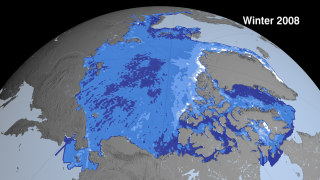
| Using five years of data from NASA's Ice, Cloud and land Elevation Satellite (ICESat), a team of NASA and university scientists made the first basin-wide estimate of the thickness and volume of the Arctic Ocean ice cover between 2003 and 2008. The scientists found that younger, thinner ice has replaced older, thicker ice as the dominant type over the past five years. Until recently, the majority of Arctic ice survived at least one summer and often several. That balance has now flipped. Seasonal ice, or ice that melts and re-freezes every year, now comprises about 70 percent of the Arctic sea ice in wintertime, up from 40 to 50 percent in the 1980s and 1990s. Thicker ice — surviving two or more years — now comprises just 10 percent of ice cover, down from 30 to 40 percent in years past.Sea ice thickness has been hard to measure directly so scientists have typically used estimates of ice age to approximate thickness. With ICESat, NASA scientists were for the first time able to monitor the ice thickness and volume changes over the entire Arctic Ocean. The Arctic ice cap grows each winter as the sun sets for several months and intense cold sets in. The total volume of winter Arctic ice is equal to the volume of fresh water in Lake Superior and Lake Michigan combined. Some of that ice is naturally pushed out of the Arctic by winds, while much of it melts in place. But not all of the ice in the Arctic melts each summer, and the thicker, older ice that survives one or more summers is more likely to persist through the next summer. This older, thicker ice is declining thinner ice that is more vulnerable to summer melt. Seasonal sea ice usually reaches about 2 meters (6 feet) in thickness, while ice that has lasted through more than one summer averages 3 meters (9 feet), though it can grow much thicker in some locations near the coast. From 2003 to 2008, multi-year ice has thinned by an average of 60 centimeters (2 feet). The total ice volume in winter has decreased by 6,300 cubic kilometers, or 40 percent. The maximum extent of multi-year ice is now one-third of what it was in the 1990s. This sequence shows Arctic sea ice thickness derived from winter and fall campaigns from the ICESat satellite. Sea ice grows extent grows in the summer and shrinks in the winter. While the sea ice extent might look similar from year to year this thickness data shows dramatic thinning especially near the North Pole (shown in dark blue). This image was generated with data acquired between Feb 17 - Mar 21, 2008. | ||
| | ||
 | | |
 (image from Smith and Siegel, 2000)

| Magnitude | Mw 6.3 |
| Region | CENTRAL ITALY |
| Abrutian Apennine | |
| Date time | 2009-04-06 at 01:32:41.4 UTC |
| Location | 42.38 N ; 13.32 E |
| Depth | 2 km |
| Distances | 59 km E Terni (pop 110,412 ; local time 03:32 2009-04-06) 7 km NW L'aquila (pop 72,279 ; local time 03:32 2009-04-06) 6 km S Pizzoli (pop 3,378 ; local time 03:32 2009-04-06) |
| Informação em: European-Mediterranean Seismological Centre | |

"O vulcão, que há meio ano não apresentava nenhuma actividade, voltou a entrar em erupção na noite da sexta-feira e regista desde então explosões constantes de material incandescente que se elevam até 600 m, sobre a cratera de 3.210 metros de altitude. Suas actividades aumentaram, no entanto, durante a noite de sábado, conforme atestaram membros do Serviço Nacional de Geologia e Mineração que realizaram ontem um sobrevou sobre a área do Llaima. De acordo com o Escritório Nacional de Emergências chileno, as chuvas deste domingo na região impedem que haja uma visão propícia da situação do Llaima."
"O governo da região da Araucanía decretou alerta vermelho em oito localidades próximas, de onde pretende evacuar umas 70 pessoas devido ao perigo que representa a queda de cinza e escória e a formação de novas inundações."
Os riscos associados à erupção vulcânica são os deslizamentos do barro resultante da mistura de cinzas vulcânicas e escombros com água, que podem provocar um aumento do volume do rio Calbuco. Situado ao sul de Santiago, o Llaima intensificou sua actividade a partir de maio de 2007.
Fonte de informação


